An acoustic screen designed by students from FA BUT will form part of the Czech exhibition at Smart City Expo in Barcelona
A prototype acoustic screen, created by first-year students
at FA BUT, will be
showcased at the Smart City Expo World Congress 2026 international trade fair
in Barcelona. This versatile interior feature, made from recycled and locally
sourced materials, will form part of the Czech national exhibition.
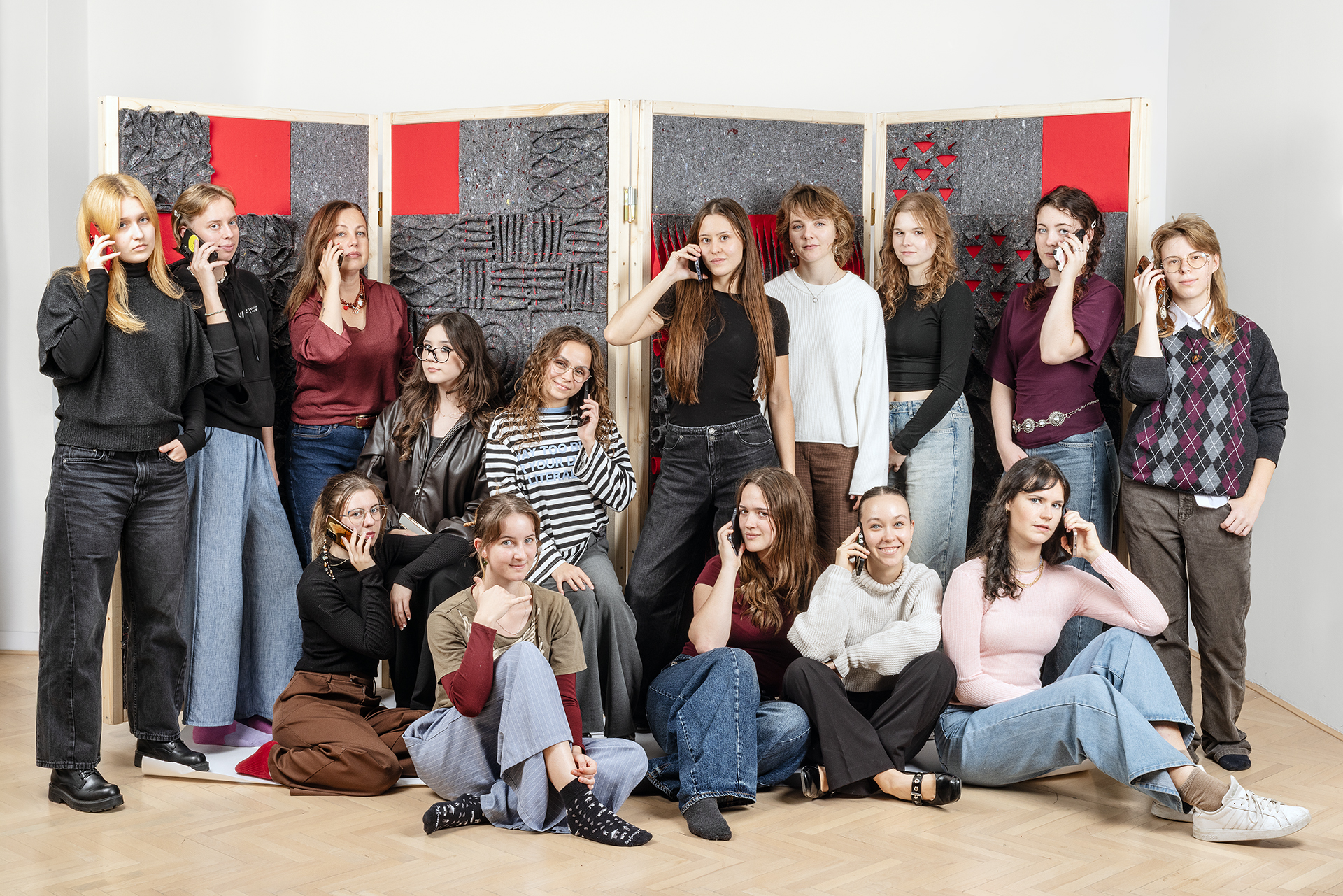 Photo: Karel Poneš
The fifteenth edition of the Smart City Expo World Congress,
one of the world’s leading events focusing on smart cities, urban innovation
and sustainable development, will take place from 3 to 5 November 2026.
The Czech Republic will be represented at the fair by a
national exhibition covering an area of almost 400 m2, bringing together
innovative companies, academic institutions, cities and other partners. This
will be the largest official Czech exhibition participation abroad across all
sectors. The exhibition is organised by the Ministry of Industry and Trade of
the Czech Republic and CzechTrade, with Veletrhy Brno responsible for its
implementation.
The Czech pavilion will also feature an installation by
first-year students from FA BUT. Their prototype acoustic screen is the result of studio-based
teaching that brought together the academic environment, the non-profit sector
and local manufacturers.
Czechia aims to win the award for the most
sustainable exhibition stand for the third time
The Czech national exhibition won the Green Exhibitor Award
for the most sustainable stand in 2024 and 2025. This year, too, it will
therefore focus on circularity, the reuse of materials and the minimisation of
waste.
It will be competing for the award against more than a
thousand exhibitors. The acoustic screen designed by students from FA BUT fits
perfectly into the exhibition concept thanks to its use of recycled materials
and their practical application in architecture.
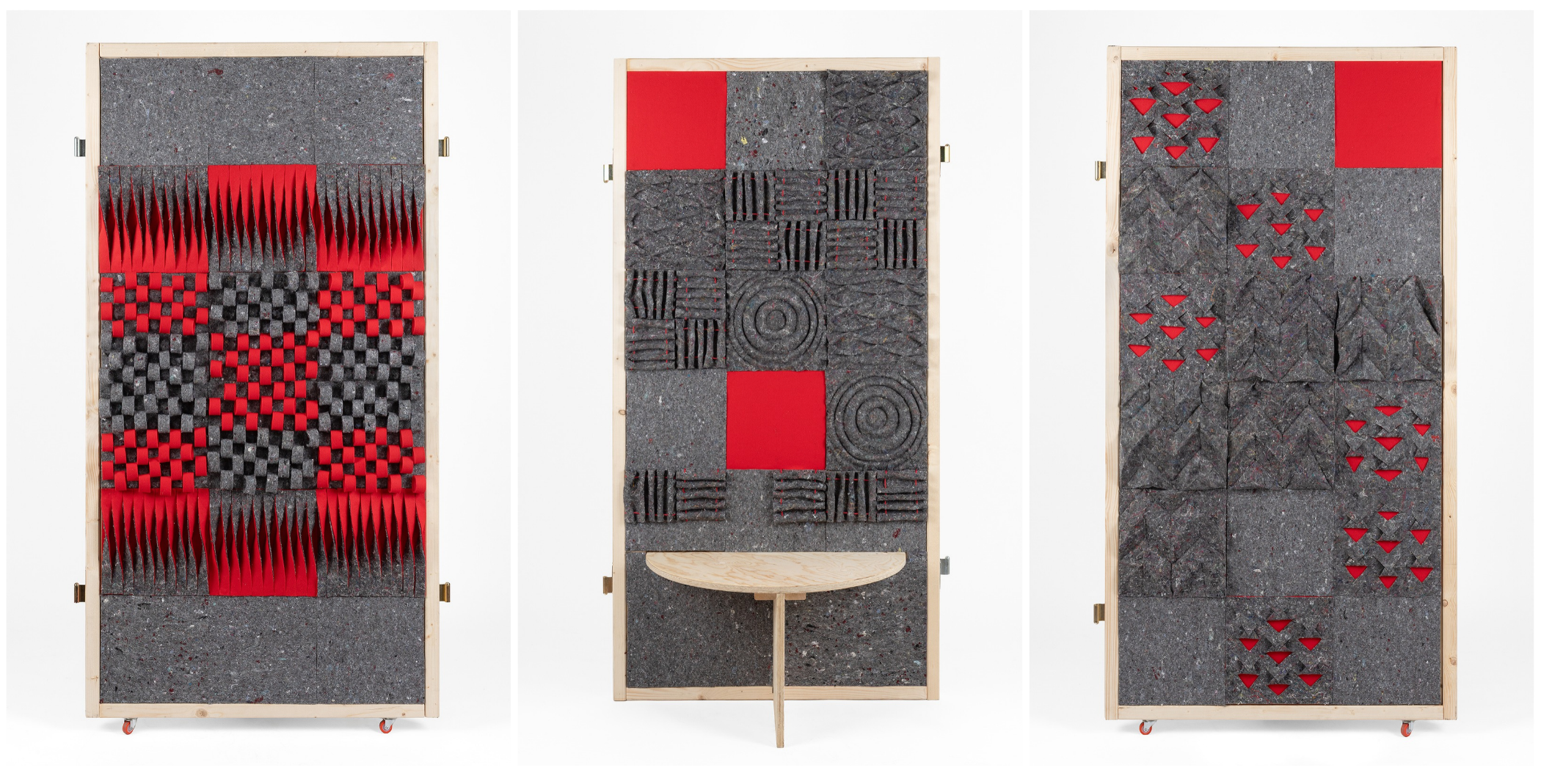 Photo: Karel Poneš
A versatile element made from local and recycled materials
The acoustic screen was created in collaboration between FA BUT and the Veronica
Foundation. This is the second joint project for both organisations. Last year,
students helped to design the interior of the foundation’s shop; this time, the
collaboration has focused on the design and production of a versatile interior
element. The studio work was led by architects Barbora Krejčová and Jitka
Ressová.
The design is based on the principle of an acoustic booth,
which allows for phone calls and undisturbed work in open-plan office spaces.
The acoustic screen can be assembled to form a wall or a more enclosed booth,
thereby adapting the degree of spatial separation to the users’ current needs.
“The students used recycled felt from a local manufacturer
and offcuts of foam rubber from a local upholstery workshop. In doing so, they
focused on finding new ways to use recycled felt and discovering its aesthetic
qualities. This felt is more affordable than decorative felt intended for
interiors and is commonly used primarily in industry as a technical textile,”
explains Jitka Ressová.
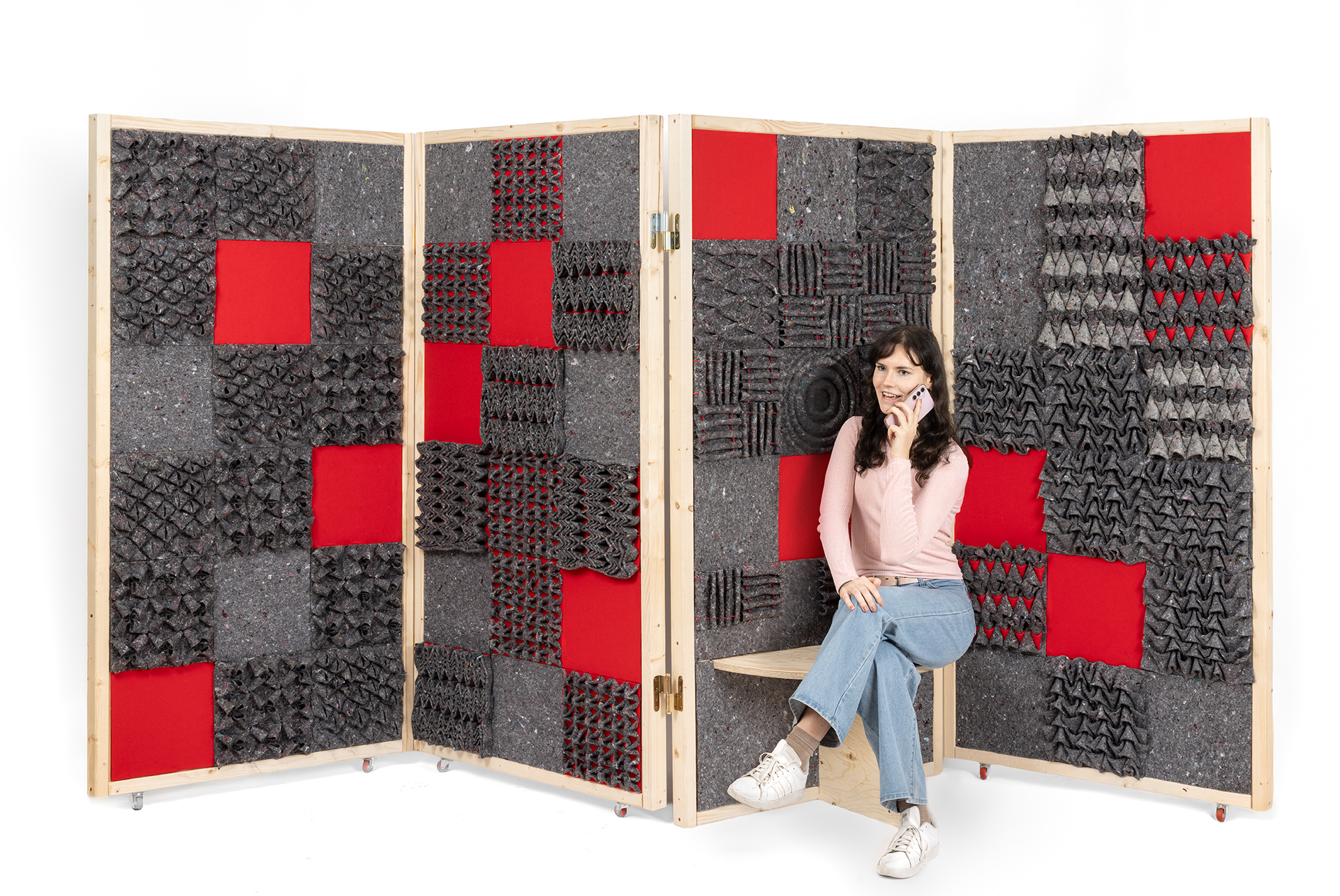 Photo: Karel Poneš
From initial design to actual realisation
The teaching took place as part of the Matter Matters
project, which aims to pilot the use of unconventional recycled and upcycled
materials in architecture.
“This time, we took on the challenge of designing and realising
an element for the exhibition, even though we were aware of the risks. The
first was the deadline, which coincided with the middle of the semester, and
the second was incorporating the topic into the first-year curriculum,”
explains Barbora Krejčová.
During the first six weeks of the semester, the students
went through the entire process, from the initial idea, through finding
technological and material solutions, to the actual implementation. They tested
the properties of the materials used in practice, responded to the challenges
associated with production, and were able to compare the original design with
how it actually functioned.
The presentation at the international trade fair in
Barcelona will now enable them to showcase the results of their work in an
international context.
“The very concept of the Czech Republic’s presentation is
comprehensive and encompasses considerations ranging from the use of materials
for the production of exhibits, through the form of the catering, to the
elimination of waste,” adds Michal Čechura, co-author of the exhibition design.
Design team
Studio leaders: Barbora Krejčová, Jitka Ressová
Collaboration: Benjamin Bárta
Students: Kateřina Hájková, Alica Jačaninová, Aneta Kadelová, Gréta Kollárová, Vanesa Kříčková, Anna Laláková, Nikola Lempochnerová, Nela Lepková, Adéla Lhotáková, Leonela Lubasová, Zuzana Matejová, Claudie Parolková, Eliška Pavelková, Natália Smolková and Hedvika Střítecká.
| Inserted by: | Rychnovská Anna Mgr. |
|---|---|
| Inserted | |
| Last updated |